
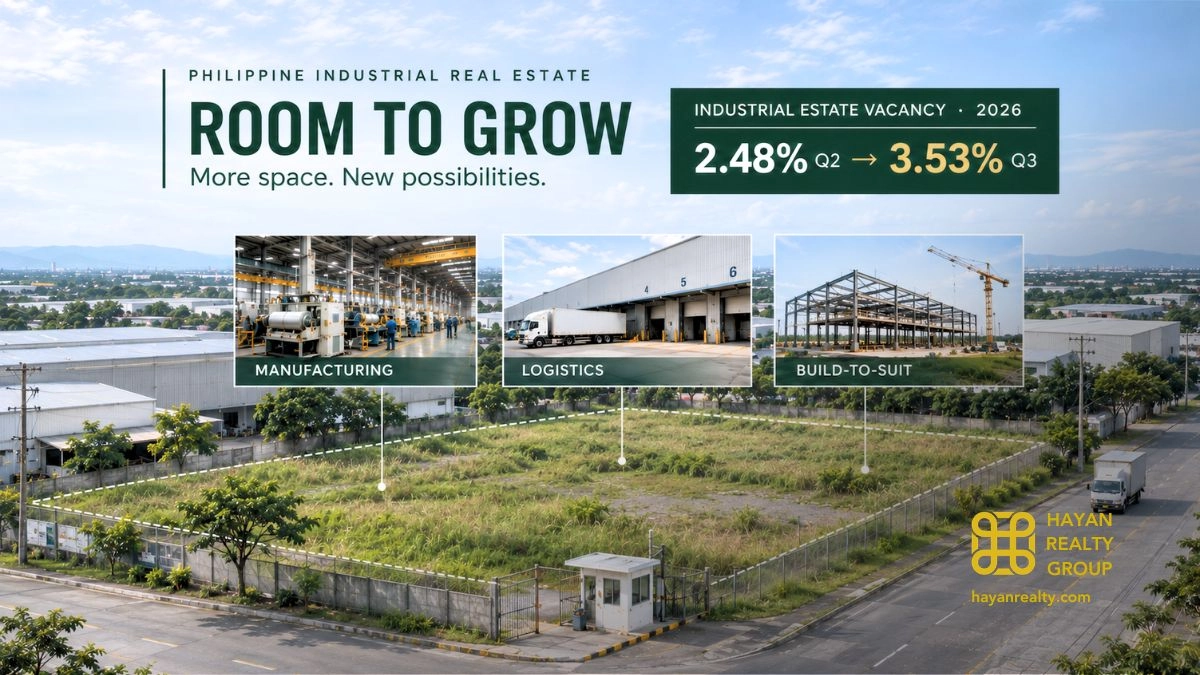
- Philippine industrial estate expansion is creating more choices for businesses seeking manufacturing, warehousing, and logistics facilities.
- National industrial estate vacancy increased from 2.48% to 3.53% in Q3 2026, largely because of newly completed developments.
- PEZA investment approvals reached ₱156.5 billion during the quarter, reflecting continued interest in industrial activity.
- CALABARZON, Central Luzon, Cebu, and Mindanao present different opportunities depending on property availability, infrastructure, and business demand.
- Additional industrial supply could benefit expanding businesses and selective property investors, particularly where developments address specific operational requirements.
More Vacant Industrial Space Could Mean More Room for Growth
More vacant industrial space might sound like bad news for the Philippine property market. But for businesses looking to expand and investors searching for the right opportunity, it could mean something else entirely: more room to grow.
The latest Philippine industrial estate expansion is bringing additional properties into the market, creating new possibilities for manufacturers, logistics operators, developers, and property investors. According to Cushman & Wakefield’s November 2026 market report, national industrial estate vacancy increased from 2.48% in the second quarter to 3.53% in the third quarter of 2026.
However, the property consultancy attributed the increase primarily to newly completed industrial developments rather than a broad weakening of occupier demand. This distinction matters because rising vacancies caused by additional supply present a different investment environment from those caused by businesses closing or reducing operations.
For companies searching for suitable facilities, additional industrial space could mean a wider selection of locations, property configurations, and development arrangements. For investors and landowners, it presents an opportunity to examine emerging industrial corridors and identify properties with credible long-term commercial potential.
Finding the Silver Lining in Rising Vacancies
Vacancy rates are often viewed as indicators of market weakness, but they can also reveal changes in the balance between available supply and business requirements. When newly completed industrial estates enter the market, it can take time for prospective occupiers to evaluate locations, negotiate agreements, and prepare facilities for their operations.
Unlike conventional residential or office properties, industrial developments frequently require specialized infrastructure and considerable operational planning. A manufacturing company may need substantial electrical capacity, while a logistics operator may prioritize highway access, loading facilities, and proximity to distribution networks. Additional supply can give these businesses more flexibility when searching for properties that meet their requirements.
For prospective industrial occupiers, a wider selection of properties could offer several advantages:
- Greater location flexibility: Businesses can evaluate more sites near suppliers, customers, transportation networks, and existing operations.
- Better facility options: Newly developed properties may offer infrastructure and configurations suited to modern manufacturing and logistics requirements.
- Room for future expansion: Companies can consider properties capable of accommodating additional operational capacity.
- Potential negotiating flexibility: Competition among available properties may create opportunities to negotiate lease terms or development arrangements.
These advantages will vary depending on local market conditions. Properties in established industrial corridors may continue to attract strong demand, while developments in less mature markets could require longer periods to secure occupiers.
Investment Activity Continues Despite Higher Vacancies
The expansion of industrial real estate is taking place alongside substantial investment activity. During Q3 2026, the Philippine Economic Zone Authority (PEZA) approved approximately ₱156.5 billion in investments, representing a 75.76% increase from the previous quarter, according to figures reported by Cushman & Wakefield.
Although investment approvals do not immediately translate into occupied industrial properties, they provide an indication of continued business interest. Manufacturing companies and other industrial enterprises require land, buildings, utilities, and transportation infrastructure before establishing or expanding their operations. As approved investments progress toward implementation, demand for suitable industrial facilities may follow.
For developers and landowners, this creates an opportunity to evaluate how existing properties could accommodate future business requirements. Rather than interpreting rising vacancies as an isolated sign of market weakness, investors can consider them alongside investment activity, infrastructure development, and the requirements of prospective occupiers.
Where Are the Industrial Property Opportunities Emerging?
Cushman & Wakefield estimated the country’s industrial estate inventory at approximately 9,400 hectares, with another 1,100 hectares scheduled for development between 2026 and 2028. However, the availability of industrial space varies considerably across the Philippines, creating different opportunities for businesses and property investors depending on their preferred locations.
CALABARZON: Established Industry With Room to Expand
CALABARZON remains one of the Philippines’ most important manufacturing and industrial corridors. Its established economic zones, proximity to Metro Manila, and access to transportation networks make it an important location for companies requiring connections to suppliers, distribution centers, and commercial markets.
With an industrial estate vacancy rate of approximately 4.10% in Q3 2026, the region offers available space within an established industrial environment. For expanding businesses, this could provide opportunities to locate near existing industry networks, while investors can evaluate properties that offer competitive infrastructure, accessibility, and development potential.
Central Luzon: A Growing Industrial Alternative
Central Luzon recorded an industrial estate vacancy rate of approximately 6.30%, reflecting a larger proportion of available space. Its established economic zones, major infrastructure connections, and access to important transportation corridors make the region relevant to businesses exploring alternatives to more established industrial locations.
Areas surrounding Clark and Subic are particularly worth considering because of their connections to aviation, maritime logistics, and regional commerce. However, the region’s development potential must be assessed alongside upcoming industrial supply and the ability of individual properties to attract suitable occupiers.
Cebu: Opportunity in a Tighter Market
Metro Cebu presents a different market situation, with an industrial estate vacancy rate of approximately 0.3%. This comparatively limited availability highlights how industrial property conditions can differ significantly between regions, even as national supply expands.
For businesses requiring industrial facilities in Cebu, identifying suitable properties may be more challenging. For developers and landowners, tighter availability could create opportunities to evaluate additional industrial capacity, provided that land costs, infrastructure requirements, and development feasibility support such investments.
Davao and Northern Mindanao: Longer-Term Growth Potential
Metro Davao and Northern Mindanao recorded a combined industrial estate vacancy rate of approximately 8.20%. Although higher vacancies indicate greater availability, they also reinforce the importance of understanding local demand before pursuing new industrial developments.
These markets may appeal to businesses and investors with longer-term strategies, particularly where agricultural processing, regional distribution, manufacturing, and logistics activity support industrial property requirements. Opportunities will depend on identifying locations with credible commercial demand rather than relying on land availability alone.
Why Build-to-Suit Developments Are Gaining Attention
One of the more encouraging developments in the industrial property market is the growing interest in facilities designed around the requirements of specific businesses. Unlike conventional warehouses constructed for general use, build-to-suit developments allow occupiers to influence the design, infrastructure, and operational configuration of their facilities.
Cushman & Wakefield reported that the build-to-suit logistics development pipeline increased by 31% quarter-on-quarter to approximately 790,000 square meters in Q3 2026. This growth suggests that some businesses are planning facilities around their future operational needs rather than simply occupying whatever industrial space is available.
For a distribution company, this may involve specialized loading areas, storage configurations, and access for large vehicles. Manufacturers may require particular electrical capacities, production layouts, ventilation systems, or other infrastructure that conventional industrial buildings cannot easily accommodate.
For developers, build-to-suit arrangements create opportunities to work more closely with prospective occupiers. For landowners, they highlight the potential value of properties that can accommodate customized industrial developments, particularly where location, utilities, and site characteristics align with business requirements.
What Rising Supply Means for Property Investors and Landowners
A growing industrial property market creates opportunities, but it also makes investment decisions more selective. Additional supply can increase competition among developments offering similar facilities, particularly in locations where several industrial projects are being completed within a relatively short period.
For property investors, this reinforces the importance of examining more than headline vacancy figures. A property may hold considerable potential if it provides access to highways, ports, suppliers, and major commercial markets, even when the surrounding region has relatively high vacancy rates. Conversely, an available property with inadequate infrastructure or limited accessibility may struggle to attract occupiers despite favorable national investment figures.
Landowners evaluating industrial development opportunities should consider land classification, zoning, utility availability, transportation access, and the requirements of prospective businesses. Depending on these factors, potential arrangements may include property sales, long-term leases, joint ventures, or developments undertaken in partnership with industrial occupiers.
The opportunity lies in identifying properties that can address genuine business requirements rather than assuming that every available industrial site represents an attractive investment.
Making Room for the Next Phase of Industrial Growth
Philippine industrial estate expansion is creating a market with more available space, more development options, and greater competition among properties. While rising vacancies deserve attention, the underlying reasons for their increase provide a more balanced picture of the industry’s direction.
Continued investment approvals and growing interest in specialized industrial facilities suggest that businesses are still evaluating opportunities for expansion. For companies searching for suitable locations, additional supply could provide greater flexibility. For investors and landowners, it creates an opportunity to identify properties positioned to serve emerging industrial requirements.
The next phase of Philippine industrial growth may ultimately depend less on how much space becomes available and more on how effectively that space is developed, positioned, and connected to the needs of businesses.
According to Cushman & Wakefield, the Q3 2026 increase was primarily driven by newly completed industrial developments entering the market rather than a broad weakening of occupier demand.
Potentially. Additional supply may give expanding businesses more choices when evaluating locations, facilities, lease arrangements, and future operational requirements.
CALABARZON, Central Luzon, Metro Cebu, and parts of Mindanao present different opportunities depending on property availability, infrastructure, industrial activity, and future demand.
Important considerations include land classification, zoning, transportation access, utilities, development costs, competing supply, prospective occupier requirements, and long-term market demand.
As industrial developments expand across the Philippines, identifying suitable properties requires an understanding of location, infrastructure, and evolving market conditions. Opportunities may range from available industrial land and commercial properties to potential development sites and long-term property partnerships.
Hayan Realty connects property owners, buyers, investors, and prospective development partners with real estate opportunities aligned with different commercial and investment objectives.
Connect with Hayan Realty to explore available properties and potential real estate development opportunities across the Philippines.