
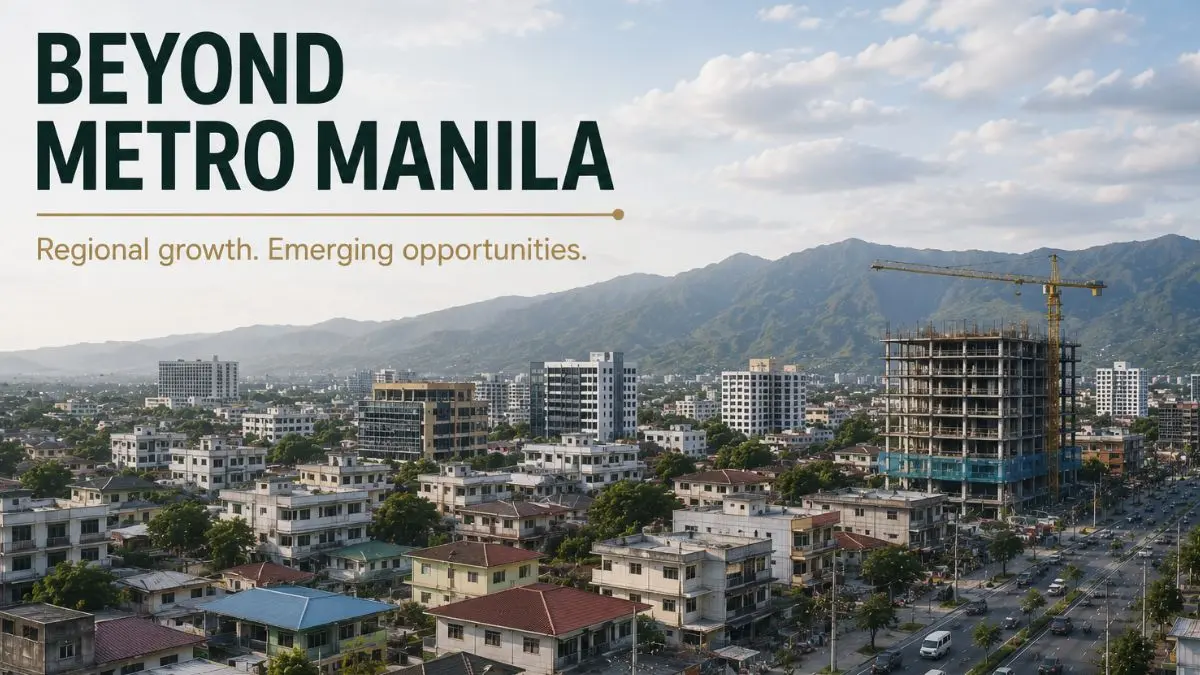
- Property activity outside Metro Manila is expanding across regional growth centers supported by infrastructure, employment, tourism, and new investment.
- Central and Southern Luzon show opportunities across townships, industrial estates, logistics, and residential development.
- Cebu, Iloilo, and other Visayas markets demonstrate how office demand, tourism, residential growth, and mixed-use development can support different property sectors.
- Mindanao markets such as Davao and General Santos are attracting residential and commercial investment as regional economies expand.
- Investors should evaluate regional markets according to their individual economic drivers and property typologies rather than treating provincial real estate as a single market.
Philippine Property Growth Is Becoming More Regional
Metro Manila remains the country’s largest and most established property market, but Philippine real estate activity is increasingly extending into regional cities and development corridors.
Recent market research from Colliers points to this geographic diversification. Central Luzon is seeing significant industrial expansion, while the Visayas and Mindanao are benefiting from residential growth, outsourcing-led office demand, tourism, and infrastructure investment. Colliers expects around 45,000 condominium units to be delivered across Visayas and Mindanao markets between 2026 and 2029, with Cebu and Davao accounting for much of the incoming supply.
For investors considering property investment outside Metro Manila, however, the opportunity is more complex than simply looking beyond the capital. Different regional economies are supporting different forms of development, making location, infrastructure, local demand, and property type increasingly important considerations.
Luzon Growth Corridors Support Multiple Property Types
Central and Southern Luzon demonstrate how improved connectivity and economic activity can support several forms of real estate at the same time.
In Central Luzon, major townships such as Alviera, Capital Town, and Centrala in Pampanga have helped establish residential and mixed-use growth around the Clark corridor. Industrial activity is also expanding across Pampanga, Bulacan, and Tarlac, with Central Luzon expected to account for around 870 hectares of new industrial supply between 2026 and 2028.
New Clark City in Tarlac, developed by BCDA, illustrates the region’s broader investment potential. The master-planned development is being positioned for industrial, technology, commercial, institutional, and residential investment, supported by infrastructure and its location within the Luzon Economic Corridor.
Southern Luzon presents another pattern. Cavite, Laguna, and Batangas continue to attract horizontal residential communities, industrial activity, and commercial development because of their connections to Metro Manila and established economic zones. Rather than functioning purely as extensions of the capital, these areas increasingly contain their own employment centers and development ecosystems.
Visayas Markets Combine Business, Tourism, and Urban Growth
In the Visayas, regional property demand is being shaped by a different combination of economic drivers.
Iloilo emerged as the leading provincial office transaction market during the first quarter of 2026, supported largely by outsourcing demand. Cebu, meanwhile, continues to combine a substantial office and residential market with tourism, retail, hospitality, and large-scale commercial activity.
Individual developments also show how regional investment is becoming more varied. The SM Seaside Cebu Arena by SM Prime, a ₱7 billion events venue, expands the commercial and leisure ecosystem around the South Road Properties area rather than adding another conventional residential project.
In Negros Occidental, The Sugartown by Megaworld is planned as a 97-hectare township near the Bacolod-Silay Airport containing residential, commercial, tourism, and town-center components. The project represents another form of regional development in which housing is integrated with employment, leisure, and commercial activity.
These examples demonstrate why the Visayas cannot be understood through a single property category. Office demand may drive one city, while tourism, residential growth, or mixed-use development creates opportunities elsewhere.
Mindanao Is Building Its Own Property Markets
Mindanao presents another set of regional opportunities shaped by local population centers, commerce, tourism, and employment.
Davao remains one of the country’s strongest property markets outside Metro Manila, with substantial residential activity alongside office, retail, and hospitality development. Regional research continues to identify the city as one of the major contributors to incoming condominium supply across the Visayas and Mindanao.
Other cities are also attracting new forms of investment. PHirst Park Homes Gen San by PHirst, for example, is a 23.7-hectare residential community in General Santos City and represents a ₱5.3 billion investment. The project demonstrates how large-scale horizontal residential development is reaching markets beyond the country’s traditional metropolitan centers.
Meanwhile, tourism-oriented markets such as Samal and emerging commercial centers such as Cagayan de Oro offer different development conditions. This reinforces the need to evaluate Mindanao city by city rather than treating the island as one uniform investment market.
Looking Beyond Location Alone
The expansion of property investment outside Metro Manila does not mean every provincial market will grow in the same way or at the same pace.
Central Luzon’s industrial pipeline is tied closely to manufacturing, infrastructure, and the Clark corridor. Iloilo’s recent momentum includes office demand. Cebu combines business activity with tourism and a mature regional property market. General Santos demonstrates potential for horizontal residential expansion, while other destinations may be better suited to hospitality, logistics, or mixed-use development.
For investors and landowners, this distinction matters. Infrastructure, employment, population, tourism, accessibility, surrounding development, and local demand should be considered alongside the type of property being proposed.
The growth of Philippine real estate beyond Metro Manila is therefore not one property boom moving from one location to another. It is the emergence of several regional markets, each shaped by different economic drivers and development opportunities.
Infrastructure investment, regional employment, tourism, industrial expansion, outsourcing, and improving connectivity are supporting demand across several Philippine growth centers.
Central and Southern Luzon, Cebu, Iloilo, Davao, General Santos, Bacolod, and other regional centers are seeing investment across different property sectors.
Depending on the location, opportunities include residential communities, industrial estates, offices, logistics facilities, hospitality developments, commercial properties, and mixed-use townships.
Local economic activity, infrastructure, accessibility, employment, population, surrounding development, demand, and the suitability of a particular property type should all be evaluated.
Hayan Realty connects investors, landowners, and property stakeholders with opportunities across strategic locations and emerging growth markets in the Philippines. If you are exploring property investments, acquisitions, development opportunities, or potential partnerships, contact Hayan Realty to discuss how we can help identify opportunities aligned with your objectives.