
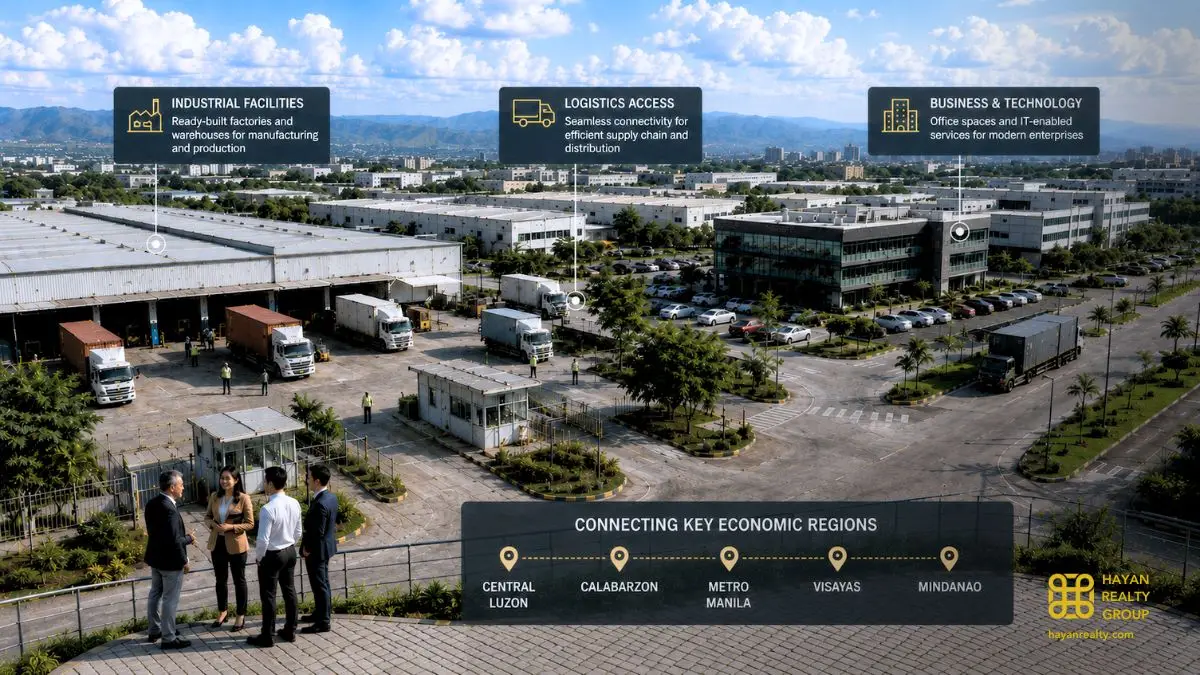
- A 40-member U.S. business delegation recently explored investment opportunities in Philippine economic zones.
- Interest spans IT, financial services, logistics, shipping, manufacturing, technology, and other growth sectors.
- Infrastructure initiatives such as the Luzon Economic Corridor are strengthening connections between major economic and industrial centers.
- For expanding businesses, access to infrastructure, logistics networks, skilled workers, and suitable commercial or industrial property remains central to location decisions.
Growing international interest is putting Philippine economic zones back in focus as businesses evaluate new locations for expansion in Southeast Asia.
In mid-2026, a 40-member U.S. business delegation met with the Philippine Economic Zone Authority (PEZA) to explore investment opportunities in the country. Participating companies represented sectors including information technology, financial services, logistics, and shipping, highlighting the range of businesses evaluating Philippine economic zones and locations for future operations.
For commercial real estate, this interest also draws attention to the locations and infrastructure that allow companies to establish and expand their presence in the country.
Economic Zones Support Different Business Requirements
Philippine economic zones accommodate more than traditional manufacturing operations. Depending on their location and specialization, ecozones can support IT and business services, logistics, warehousing, industrial facilities, technology companies, and other commercial activities.
This variety gives businesses more options when matching operational requirements with suitable locations. Companies dependent on manufacturing and distribution may prioritize access to ports, expressways, and logistics networks, while technology and service-oriented firms may place greater emphasis on workforce availability, digital infrastructure, and proximity to established business centers.
For property investors and businesses evaluating expansion, understanding these differences is an important part of identifying locations that can support both immediate operations and long-term growth.
Infrastructure Is Expanding the Investment Map
Infrastructure development is also influencing where businesses look for opportunities. The Luzon Economic Corridor, for example, is designed to strengthen connectivity between Subic Bay, Clark, Metro Manila, and Batangas, linking several of Luzon’s major industrial, logistics, and commercial centers.
Improved connections between these locations can strengthen the appeal of commercial and industrial properties beyond Metro Manila, particularly for businesses that require access to ports, airports, manufacturing clusters, and regional markets.
New Clark City also illustrates how Central Luzon’s investment landscape is expanding beyond traditional industrial development, with emerging initiatives exploring technology, digital infrastructure, and other higher-value industries.
What Businesses Should Look for in an Ecozone
Growing investment interest does not make every location equally suitable for every business. Companies evaluating Philippine economic zones still need to consider how a location supports their specific operations, workforce, supply chain, and long-term expansion plans.
Access to major roads, ports, airports, utilities, telecommunications, and logistics services can be particularly important for manufacturing and distribution businesses. PEZA economic zones can also provide infrastructure and facilities ranging from utilities and telecommunications to warehouses and ready-to-occupy factory buildings, depending on the location.
Available property should also match the company’s intended use and future space requirements. PEZA’s current listings illustrate the variety available across ecozones, including industrial land and standard factory buildings in locations such as Pampanga.
As international companies continue exploring opportunities in the Philippines, selecting the right commercial or industrial location will remain an important part of turning investment interest into viable long-term operations.
Economic zones combine locations suited to manufacturing, technology, logistics, and business services with infrastructure, investment facilitation, and incentives available to qualified PEZA-registered enterprises.
Manufacturing remains the largest segment of PEZA’s 2026 approvals, alongside IT-BPM, ecozone development, facilities, logistics, tourism, utilities, and domestic-market projects.
Companies should evaluate transportation access, utilities, telecommunications, workforce availability, logistics connections, available property, and whether the location supports their operational and expansion requirements.
If you’re evaluating an ecozone, industrial site, or commercial location for your next expansion, Hayan Realty can help you understand the property and market factors behind the decision. We work with businesses, investors, property owners, and developers to identify opportunities aligned with both immediate requirements and long-term growth.